Horny Villa review: a merge game with a mansion attached

The verdict
Merge games live or die on one question — does the board ever feel solvable, or does it always feel one slot short? Horny Villa mostly lands on the right side of that, with enough board space early that combining items feels productive rather than cramped, and a renovation goal that gives the merging somewhere to go.
It is a reasonable pick for anyone who wants a low-stakes puzzle to pick up and drop. Sessions are naturally short, nothing punishes you for leaving, and the mansion progress gives a visible record of time spent.
It is a poor pick if you dislike being asked to wait. Merge design depends on item generators that produce on a timer, and past the early game the limiting factor stops being your board reading and becomes the clock. That is the genre working as designed, not a flaw specific to this game, but it is the thing most likely to make you stop playing.
Nine interface languages including Polish is unusually broad for the catalogue and worth noting if English is not your first choice.
How Horny Villa actually plays
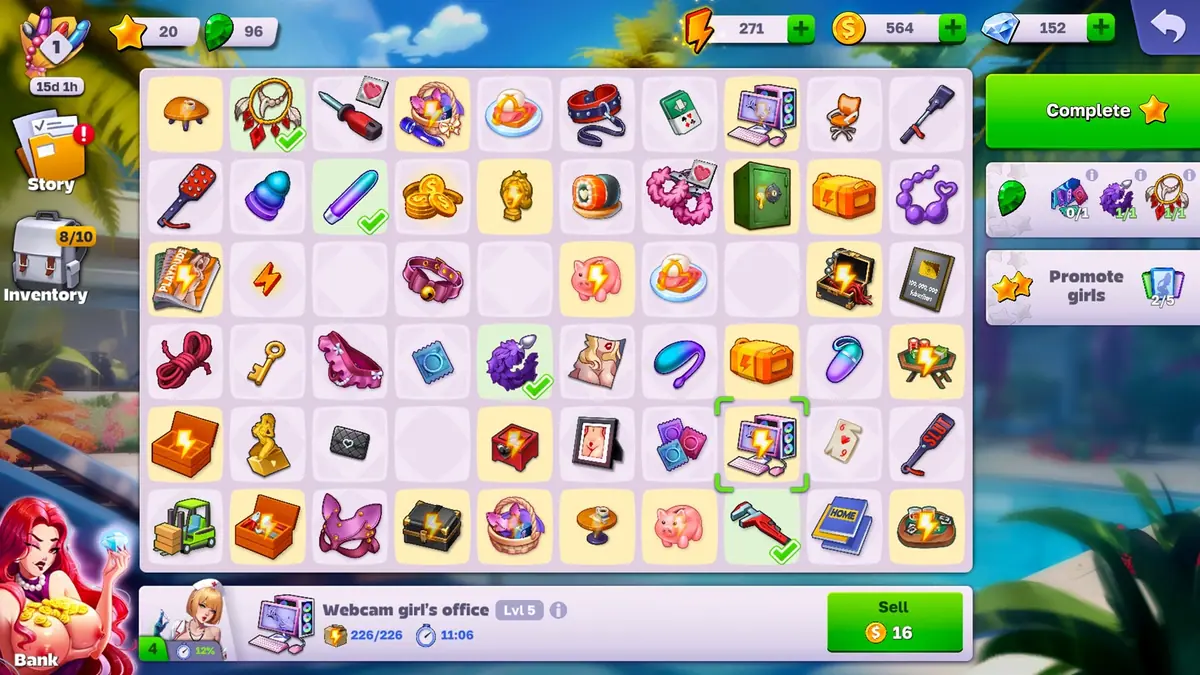
The board is the game. You have a grid of items, you drag identical ones together, and two of a kind become one of the next tier. Merge those and the cycle continues upward. Progress comes from producing high-tier items that quests demand, and the puzzle is working out which chains to advance now given limited space.
Space is the real constraint and the source of whatever difficulty exists. Every item occupies a slot, generators need slots too, and a board choked with low-tier clutter cannot advance anything. Good play is largely inventory discipline — knowing when to clear rather than hoard.
Quests drive it. The mansion needs furniture and decor, each request wants specific items at specific tiers, and completing them unlocks new areas and new generators. This is the progression skeleton and it is a clean one: you always know what you are working toward and roughly how far away it is.
Around the merging sits a relationship layer with the game's cast, advanced by completing renovation goals rather than by separate dialogue play. It is the reward track rather than a second game — do not expect the branching writing of a visual novel.
The game is tagged Resource Management, which undersells it. The management is specifically merge-board management, and if you have played the mainstream mobile merge titles you already know the loop.



What the free version really gets you
Horny Villa is free to play and monetises the two things merge games always monetise: board space and time. Premium currency buys energy for generators, additional storage, and occasionally direct item grants that skip a chain you do not want to build.
Early progress is comfortable free. The opening hours hand out enough generator charges that the board keeps moving, and the first several renovation goals arrive quickly enough to feel like momentum.
The change is gradual rather than a wall. Quests begin asking for items several tiers up, each tier doubles the inputs beneath it, and generator output stays flat. The result is that a free session shifts from twenty minutes of merging to five minutes of merging and a wait. Nothing locks; the pace simply drops until spending or patience resolves it.
There is no player-versus-player mode, so nobody else's spending affects you. That makes this pay-to-accelerate in the cleanest sense — you are purchasing your own time back and no one is beating you with a credit card. If you do spend, storage upgrades outlast energy refills, because space is the permanent constraint and energy is consumed the moment you use it.
Horny Villa vs. the alternatives
| Game | Core loop | Free content ends | Pay-to-win? | Pick it if |
|---|---|---|---|---|
| Horny Villa | Merge identical items up through tiers to satisfy mansion renovation quests; board space is the constraint. | No hard stop. Sessions shorten steadily as quests demand higher tiers and generator output stays flat. | No competitive mode at all — purely pay-to-accelerate. | You want a low-stakes puzzle with visible long-term progress and no competition. |
| Cunt Merge | Same merge fundamentals with a lighter progression wrapper and less renovation structure. | Sooner, with a thinner quest track to pull you forward. | Pay-to-accelerate. | You want the merge loop without the mansion metagame. |
| Kink Inc. | Tycoon management with staff and facilities instead of a merge board. | Later — income scales rather than staying flat like generator output. | Pay-to-accelerate. | You like the management framing but find merge boards fiddly. |
Questions people actually ask
Is Horny Villa a merge game?
Yes. The publisher describes it as a merge game and the core loop is combining two identical items into one of the next tier. It is tagged Resource Management, which undersells what the game actually is.
Is Horny Villa pay to win?
There is no competitive mode, so no other player's spending can cost you anything. Money buys generator energy and storage space, which is pay-to-accelerate in the cleanest sense of the term.
Why has my Horny Villa board stopped progressing?
Almost always because it is full of low-tier clutter. Every item takes a slot and a choked board cannot advance any chain. Clearing aggressively is more useful than hoarding items you might need later.
What should you buy first in Horny Villa?
Storage upgrades before energy refills. Space is the permanent constraint in a merge game, while energy is consumed the moment you spend it.
What languages does Horny Villa support?
Nine, including English, German, Russian, Portuguese, Italian, French, Polish, Spanish and Turkish. That is unusually broad for this catalogue, most of which is English-only.
Can you play Horny Villa on mobile?
Yes, and it is arguably better there — dragging items around a merge board is a touch-native interaction, and there is an Android build alongside the browser version.
If you like Horny Villa, try these





Filed under Casual · BDSM · Big Ass · Big Breasts · Bondage · CCG · Comedy