Idle Studs review: a tycoon idler built for the gay audience
The verdict
Worth stating first because the catalogue makes it hard to find: Idle Studs is explicitly a gay title, and the roster, art and framing are built for that audience rather than adapted for it. If that is what you are looking for, the search usually takes longer than the game does.
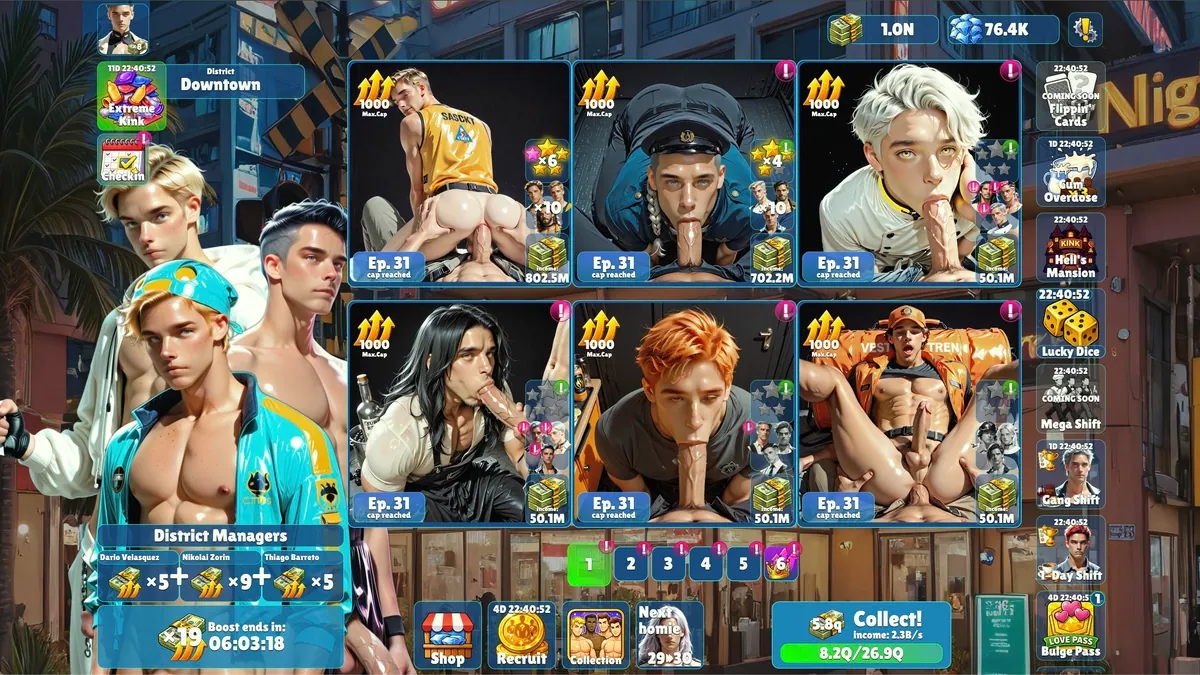
Mechanically it is a tycoon idler. You recruit staff, assign them to venues, upgrade their output, and income accrues whether or not you are watching. There is a clicker layer for active play and a leaderboard for competitive players, so it covers both the leave-it-running and the check-in-constantly styles.
The thing that separates it from the flatter idlers in the catalogue is the pairing system — Homies produce, Buddies boost them, and the combinations compound rather than simply adding up. That gives the mid game an optimisation problem instead of a straight wait.
Skip it if leaderboards make you anxious. The competitive ranking is real-time and the rewards attached to it are meaningful, which quietly converts a relaxed idler into a game that wants your attention on a schedule.
How Idle Studs actually plays
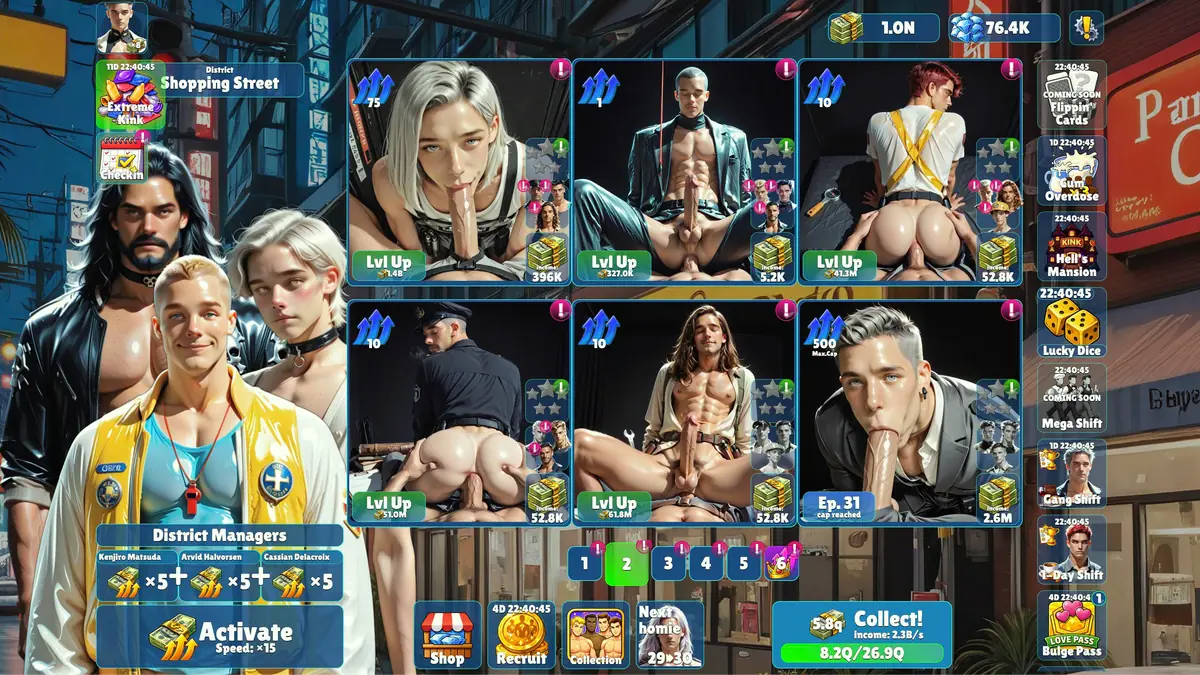
You recruit Homies, each with their own earning rate, and put them to work across themed venues — bars, lounges, spas. Each venue has upgrade tracks, and each Homie has a personal progression track, so income growth comes from two directions at once.
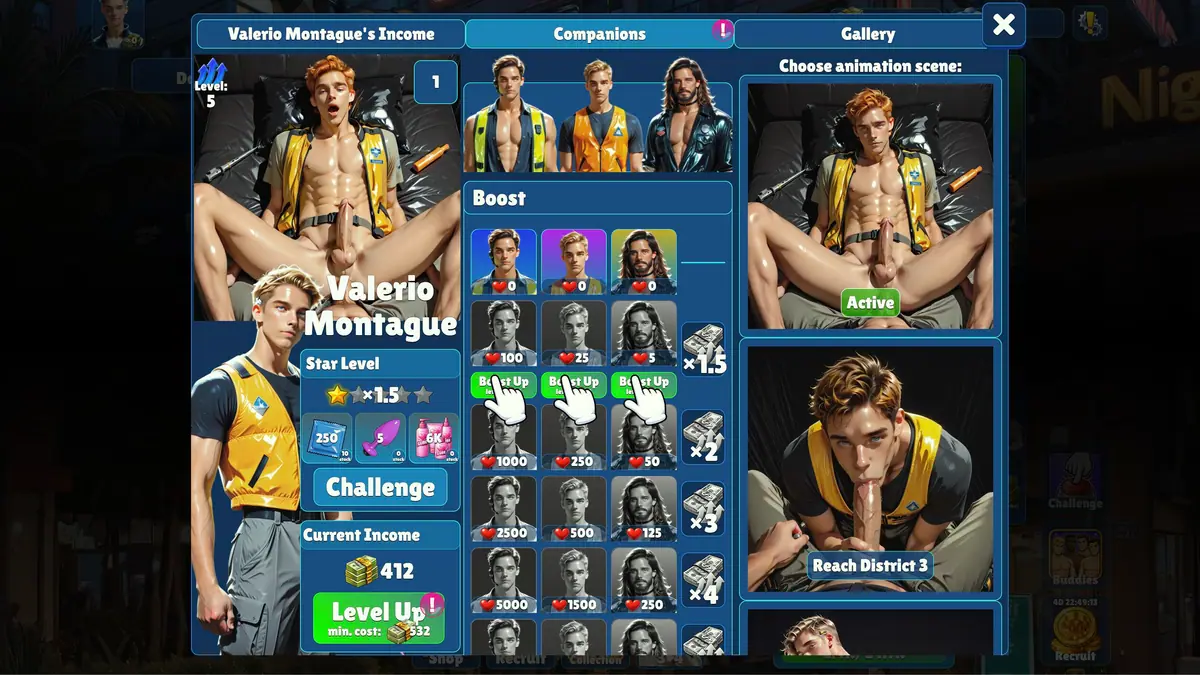
Buddies are the layer that makes it interesting. Pairing a Buddy with a Homie boosts production, and the boosts interact rather than stacking linearly, so the optimisation question is which pairings to prioritise given limited upgrade resources. This is where the game asks something of you; without it, it would be a straight number-goes-up idler.
Idle missions send Buddies out to gather resources over real time, returning with materials that feed upgrades. That gives the offline period a second output stream beyond raw income, and it means logging in has two things to collect rather than one.
The clicker system is for hands-on bursts. When you want to play actively rather than wait, clicking generates items that accelerate upgrades. It is not deep, but it means an active session has something to do rather than just spending accumulated currency and closing the tab.
Leaderboards run in real time against other players, with rare recruits and upgrades as ranking rewards. Because rankings reset and reward on a schedule, competitive play requires being present at the right times.

What the free version really gets you
Idle Studs is free to play and monetises the standard idle levers: income multipliers, time skips, and premium recruits.
No energy system limits your session, which is the usual and welcome property of the idle genre. You can play as long as you like; the constraint is how fast income accrues, and that is what money changes.
The free curve behaves as idle curves do. Early progression is fast and satisfying because each upgrade is affordable relative to your income. The mid game is where the exponent catches up — upgrade costs scale faster than production, sessions get shorter, and the gap between logging in and having something to spend widens from hours to a day.
The leaderboard is where free and paying players actually collide. Everything else in the game is a private curve nobody else affects, but ranking rewards are finite and distributed by position, so a paying account taking a top slot takes it from someone. That makes the competitive layer genuinely pay-to-win while the rest of the game remains pay-to-accelerate.
If you spend, permanent multipliers beat consumables for the same reason as in any idler: idle income compounds, so a rate increase keeps paying and a time skip pays once.
Idle Studs vs. the alternatives
| Game | Core loop | Free content ends | Pay-to-win? | Pick it if |
|---|---|---|---|---|
| Idle Studs | Recruit Homies, pair them with Buddies for compounding boosts, assign to venues, collect idle income. | No hard stop. Mid-game upgrade costs outpace production, stretching the gap between useful sessions. | Yes on the real-time leaderboard, where rewards are position-based. Pay-to-accelerate everywhere else. | You want an idler with an actual optimisation problem, and you want a gay-focused roster. |
| Fap Titans | Click and idle damage against monster stages; prestige resets for permanent multipliers. | Similar curve, but progression is one-dimensional — damage per second and nothing else. | No competitive mode at all, so purely pay-to-accelerate. | You want the simplest possible idle loop with no leaderboard pressure. |
| Kink Inc. | Tycoon management with staff and facility upgrades, closer to a business sim than a clicker. | Later, since income scales with more variables than a single production stat. | Pay-to-accelerate. | You want management depth and a straight-focused roster. |
Questions people actually ask
Is Idle Studs a gay game?
Yes, explicitly. The roster, art and framing are built for a gay audience rather than adapted for it, which is worth knowing up front because the catalogue makes titles like this hard to filter for.
Is Idle Studs pay to win?
On the real-time leaderboard yes, because ranking rewards are finite and awarded by position, so a paying account taking a top slot takes it from someone else. The rest of the game is a private curve and purely pay-to-accelerate.
What is the difference between Homies and Buddies?
Homies are the earners you assign to venues. Buddies boost them when paired, and the boosts compound rather than adding linearly, which turns upgrade allocation into a genuine optimisation problem.
Does Idle Studs have an energy system?
No. You can play for as long as you want. What limits you is the rate at which income accumulates, not a stamina meter, which is standard for the idle genre and one of its better properties.
What should you upgrade first in Idle Studs?
Permanent income multipliers before consumable time skips. Idle income compounds, so a rate increase keeps paying out indefinitely while a skip pays once and is gone.
Can you play Idle Studs without competing?
Yes, though you will forfeit the leaderboard rewards, which include rare recruits. The single-player progression works perfectly well on its own — you simply advance more slowly than ranked players.
If you like Idle Studs, try these
Filed under Idle · Gay · Idle · Resource Management